Indian market hours, expiries and MCX evenings
When NSE, BSE, the currency segment and MCX are open, how weekly and monthly expiries, lot sizes and freeze quantities work, and what a closed market means for a strategy that runs on its own.

If you automate anything on Indian markets, the calendar and the clock are part of the rule whether you wrote them in or not. A strategy that works on a 15-minute chart has to know when the first 15-minute candle begins, when the last one ends, which contract it is trading this week and what happens to that contract on expiry day. None of this is complicated, but all of it has to be exact. This post sets out the facts as they stand and points to where they change.
One caution before the detail: exchange timings, expiry days and contract specifications are set by the exchanges and the regulator and are revised from time to time. Treat what follows as the shape of things, and check the current rules with your broker and the exchange, especially around holidays and any changes to expiry schedules.
The sessions
NSE and BSE cash market. The equity session runs from 09:15 to 15:30 IST, Monday to Friday, with a short pre-open period before 09:15 in which orders are collected and an opening price discovered. Equity derivatives (index and stock futures and options) trade in the same 09:15 to 15:30 window.
Currency derivatives (CDS). Currency futures and options on NSE and BSE open earlier than the cash market and run until 17:00 IST. If you trade USD-INR against something else, note that the session outlasts the equity close by an hour and a half.
MCX commodities. The commodity exchange opens in the morning and runs into the late evening: until 23:30 IST for much of the year, and somewhat later during the US winter months when the overseas reference markets shift. Gold, silver, crude oil, natural gas and base metals therefore trade through the European and most of the US session, which is why MCX evenings feel like a different market from the Indian morning.
Holidays differ by segment. The cash market, the currency segment and MCX do not always close on the same days, and MCX sometimes trades only part of the day on a date the equity market is closed. Check your broker's calendar rather than assuming.
Weekly and monthly expiries
Index options on the main indices have weekly expiries as well as a monthly one, with the expiry falling on a set weekday that the exchanges have changed more than once. Stock options and most futures expire monthly, typically in the last week of the month. On expiry day the contract settles, and anything you still hold is closed out or exercised under the exchange's rules.

Three things follow for an automated trader. First, a strategy that trades "the nearest weekly contract" is trading a different instrument every week, and the price history of one contract is not the price history of the next. Second, expiry day itself behaves differently: time value collapses, liquidity moves to the next contract, and a rule tested on ordinary days may have never seen one. Third, if a strategy runs into expiry with a position open, something will happen to that position whether the rule has an exit or not. Decide in advance whether the rule may hold into expiry, and if not, write a time exit.
Lot sizes and freeze quantities
Futures and options are traded in lots, and the lot size for each underlying is set by the exchange and revised from time to time. A quantity in a strategy for an index or a stock derivative is therefore a number of lots, not a number of shares, and the money at risk per lot depends on the lot size and the contract price. When the exchange changes a lot size, a rule that sizes by lots changes its risk without a single parameter being edited. Lot size belongs in your review checklist.
A freeze quantity is the maximum quantity a single order may carry for a given contract. An order above it is rejected by the exchange, not queued. A strategy that scales up its size, or that pyramids, needs to know the freeze limit and split larger orders, or it will see rejections at exactly the moments it wants to trade most.
What a closed market means for an automated trader
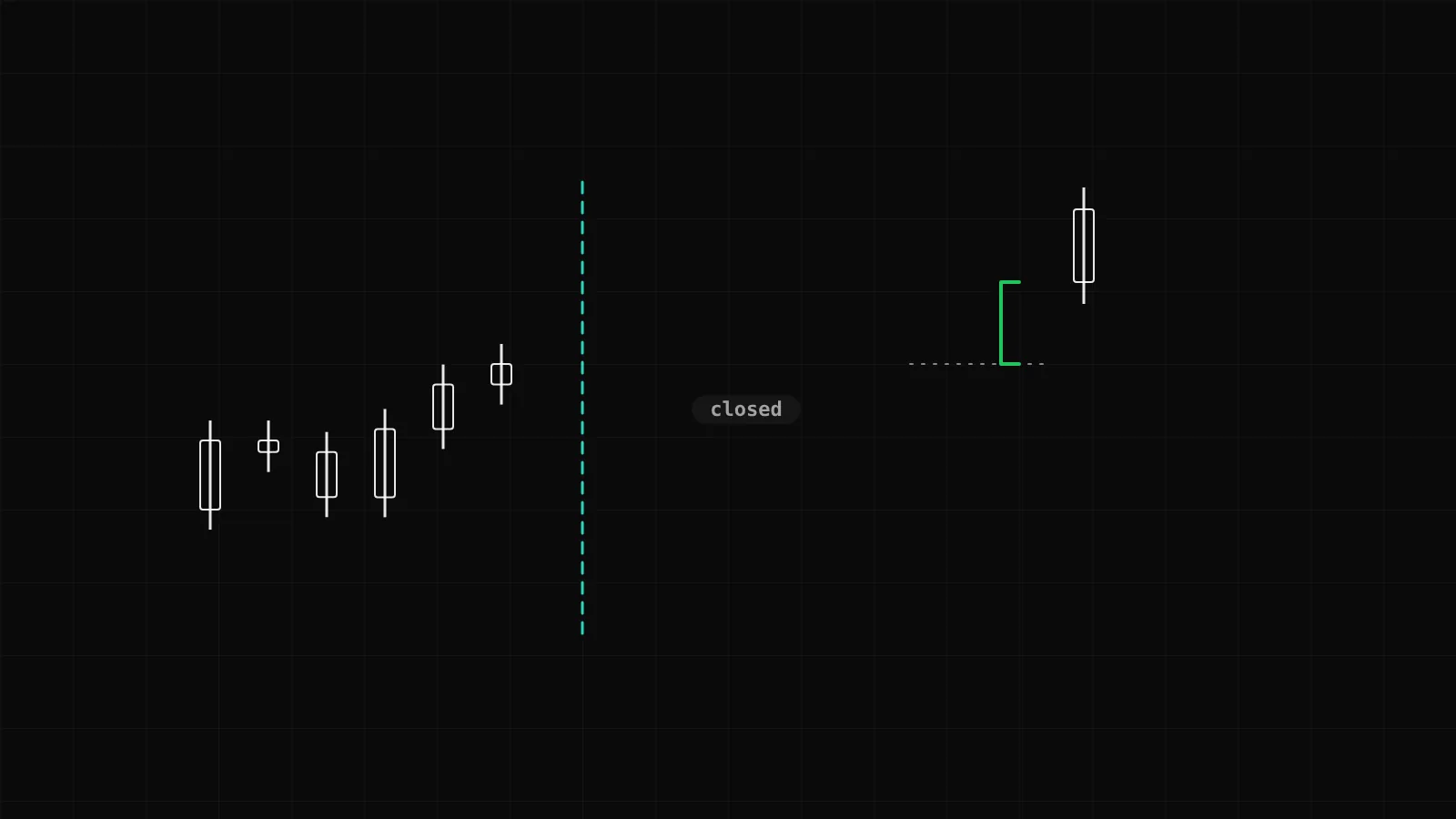
A strategy does nothing useful in a closed market, but it can still do several unhelpful things.
It can wait with a stale view. The last traded price at 15:30 is not the price at 09:15 the next day. A rule evaluated against the previous close at the open will often fire on a move that happened overnight, which is not what it was tested on. Make sure the rule only evaluates on candles formed in the session.
It can leave orders behind. Pending orders at the broker may be cancelled at the close, carried to the next session or rejected depending on the product type and the broker. Intraday products are squared off by the broker shortly before the close at a time the broker sets, which is a forced exit the rule did not plan. Know which product your strategy uses and what the broker does with it at 15:30.
It can meet a gap. A position held overnight reopens at whatever the market decides. A stop-loss does not protect against a gap; it fills at the next available price after the open. If the rule is intraday, confirm it is flat by the close. If it is not, the overnight gap is part of its risk and should be sized for.
It can lose its connection. Indian broker sessions expire daily. A strategy whose broker login lapsed overnight cannot place the first trade of the morning. A morning check before 09:15 is part of running anything automated on Indian markets.
How DalRoti helps
DalRoti treats the Indian clock as data. Intraday candles for Indian symbols start at 09:15 IST, so a 15-minute strategy sees the same candle boundaries the exchange does. Time exits can be set as a number of minutes before the 15:30 IST close. When a symbol's market is closed, the strategy card says so and shows when it opens; a running strategy takes no entries until then, and watchlist rows show "Closed" with the last traded price.
For indices, the builder's "Trade via" setting picks the current, next or far-month future, or an option by moneyness and expiry (nearest weekly, next weekly or monthly), and shows the exact contract it would select right now, so the rolling-contract question is visible rather than hidden. Contracts can be typed straight into search, for example "RELIANCE DEC FUT" or "NIFTY 24 NOV 23500 CE", and the words "gold" or "crude" list the front-month MCX contract first. Live NSE, BSE and MCX prices come through your own connected Indian broker; when a daily session has expired, the app shows that it needs today's login, and a morning reminder at 08:30 IST can be switched on in notification settings.
Trading involves a high risk of loss. DalRoti is a software tool and does not guarantee any profit. Decide your own risk and position size.
AI Generated